

Green beans are one of the most productive vegetables you can grow in a home garden. Plant a short row in spring and you’ll be picking more than you can eat by midsummer. They ask for very little — warm soil, some sun, and regular water — and they give back abundantly.
Whether you choose bush beans that need no support or pole beans that climb a trellis and produce all season, this guide walks you through everything you need to know from planting to your first harvest.
Bush Beans vs. Pole Beans — Which Should You Grow?
This is the first choice to make, and both are excellent options depending on your space and how you like to garden.
Bush beans grow as compact, self-supporting plants 18–24 inches tall. They produce a heavy flush of beans all at once over 2–3 weeks, then the harvest slows. This makes them ideal if you want a big batch for canning or freezing. Plant a new row every 2–3 weeks for continuous harvest. Popular varieties: ‘Blue Lake 274,’ ‘Provider,’ ‘Contender.’
Pole beans climb a trellis, fence, or poles to 6–8 feet tall. They start producing a few weeks later than bush beans but then keep going steadily all season until frost. One planting feeds you for months. They’re also more productive per square foot — great if you’re short on garden space. Popular varieties: ‘Kentucky Wonder,’ ‘Rattlesnake Pole Bean,’ ‘Fortex.’
For most home gardeners, bush beans are the easier starting point. Once you’re comfortable with them, pole beans are worth trying for their long harvest season.
When to Plant Beans
Beans are warm-season crops that absolutely must be planted after your last frost date. Unlike some vegetables that tolerate light frost, beans are killed by freezing temperatures — and even cold soil slows germination and leads to rot.
Wait until soil temperature is at least 60°F, ideally 65–70°F, before planting. In Zones 5–7, this is typically late May. In Zones 8–9, you may be planting as early as March or April.
In most zones, you can plant a second crop in midsummer (about 8 weeks before your first fall frost) for a fall harvest. Beans grow quickly, and a late planting often produces as well as the spring one.
For exact dates in your zone: When to Plant Beans · Find Your Zone
Choosing the Right Spot
Beans need full sun — at least 6–8 hours of direct sunlight per day. They’ll grow in partial shade, but yields drop noticeably. Choose the sunniest spot in your garden.
Avoid spots where you’ve grown beans or other legumes in the past 2–3 years if you had disease problems. Rotating to a different bed helps break pest and disease cycles.
For pole beans, plan your trellis or support structure before you plant. A simple teepee of bamboo poles, a wire fence, or a wooden trellis all work well. Position it so it doesn’t shade shorter plants to the south.
Preparing the Soil
Beans are one of the few vegetables that actually improve your soil. They fix nitrogen from the air through bacteria in their roots, adding fertility back to the soil for next year’s crops.
This means beans don’t need heavily fertilized soil — in fact, too much nitrogen produces lush foliage at the expense of bean production. Work in a moderate amount of compost before planting, but skip the high-nitrogen fertilizers.
Beans need well-draining soil. Soggy soil causes seed rot before germination and root rot later. If your soil is heavy clay, raised beds or amended beds with extra compost will give you much better results.
How to Plant Beans
Beans are sown directly in the garden — they don’t transplant well because their roots are sensitive to disturbance. Direct sowing is also fast and easy.
Plant seeds 1 inch deep and 3–4 inches apart. For bush beans, space rows 18–24 inches apart. For pole beans, plant 4–6 seeds in a circle around each pole or every 6 inches along a trellis.
Seeds germinate in 8–14 days when soil is warm. Don’t plant in cold, wet soil and then wait — you’re more likely to get rot than seedlings.
For a continuous harvest of bush beans, make a new sowing every 2–3 weeks until about 8 weeks before your first fall frost.
Watering Your Beans
Beans need about 1 inch of water per week. Consistent moisture is most critical during two stages: germination (when the soil should stay evenly moist) and flowering and pod development (when uneven watering causes flowers to drop and pods to be misshapen or tough).
Water at the base of plants — wet leaves and pods invite disease, especially bean rust and powdery mildew. Drip irrigation or a soaker hose works particularly well for beans.
Mulch around plants to hold moisture and prevent soil from splashing up onto lower leaves during watering or rain.
Fertilizing
Because beans fix their own nitrogen, they don’t need much fertilizer. If you’ve worked compost into the soil before planting, skip fertilizing entirely. If plants look pale or grow very slowly, a single application of a balanced fertilizer early in the season is sufficient. Avoid high-nitrogen fertilizers at any point — they push leafy growth and reduce your bean harvest.
Common Bean Problems
Poor germination: Almost always caused by cold, wet soil. Wait for soil to warm to 60°F before planting. Old seeds also germinate poorly — use fresh seeds each season.
Mexican bean beetles: Small, round, yellow-orange beetles and their spiny larvae that skeletonize leaves. Handpick adults and larvae, and crush yellow egg clusters on the undersides of leaves. Row cover at planting prevents beetles from reaching the plants.
Aphids: Clusters of small insects under leaves and on stems. Knock them off with a strong stream of water, or spray with diluted insecticidal soap.
Bean rust: Orange-brown pustules on the undersides of leaves, usually in warm, humid weather. Remove and destroy affected leaves, avoid overhead watering, and improve airflow between plants.
Dropped flowers: Beans drop flowers when temperatures exceed 90°F or when water is inconsistent. Keep soil evenly moist during hot spells and water in the evening to help cool plants.
How to Harvest Beans
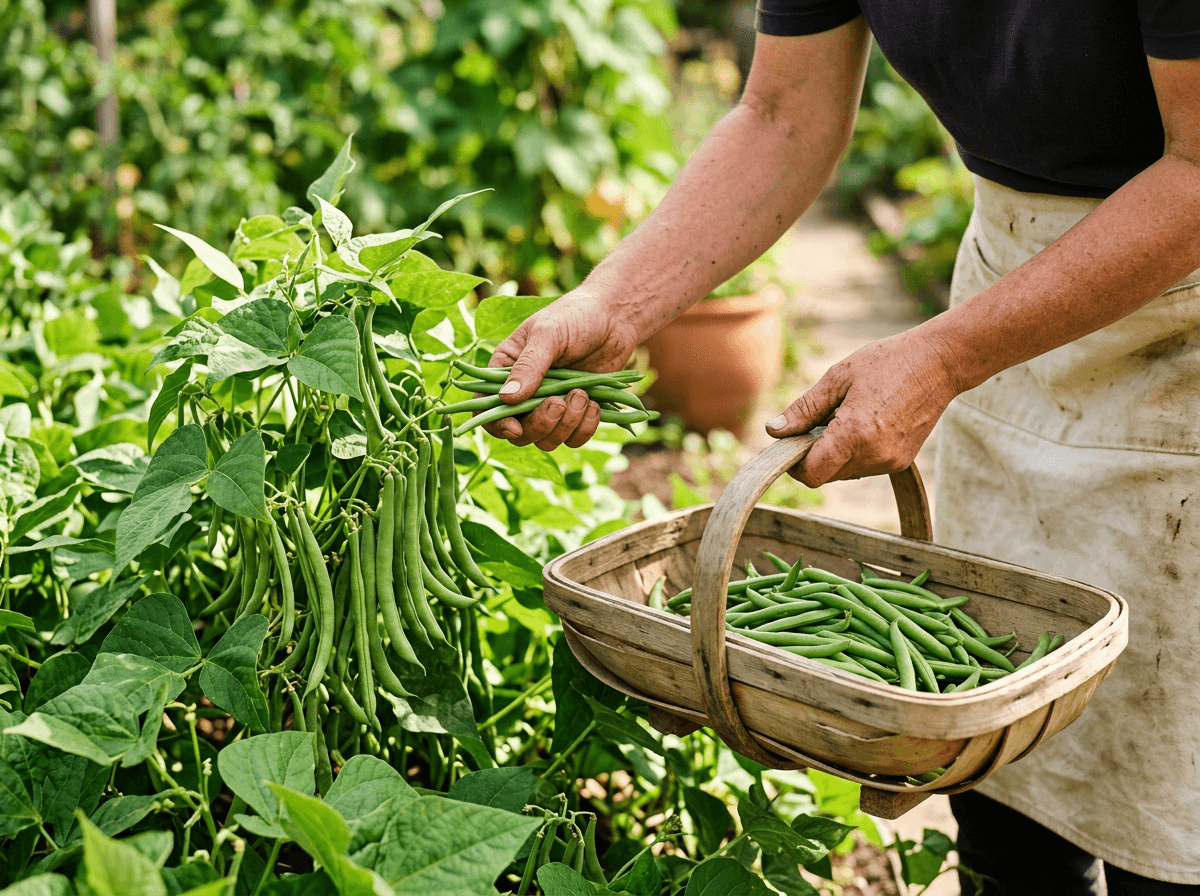
Harvest bush beans when pods are firm, crisp, and about pencil-thickness — typically 50–60 days after planting. At this stage the seeds inside are still small and the pod snaps cleanly. Don’t wait for pods to swell and bulge — they become tough, stringy, and less flavorful.
Pick every 2–3 days once beans start producing. This is the most important harvesting tip: leaving mature pods on the plant signals it to stop producing. Regular picking keeps the plant in production mode.
Pole beans produce continuously for 8–10 weeks or more when picked regularly. Check plants every other day at peak production.
Harvest in the morning when pods are crisp. Use two hands — hold the stem with one hand and pull the pod with the other to avoid tearing the plant.
Storing Fresh Beans
Fresh green beans keep for 5–7 days in the refrigerator in an open bag or container. Don’t wash them until just before use — moisture speeds deterioration.
For longer storage, blanch beans for 3 minutes in boiling water, cool in ice water, dry, and freeze in bags. Frozen beans keep for up to a year and work well in soups, stews, and casseroles. They’re also easy to pressure can — a satisfying way to preserve a big harvest.


