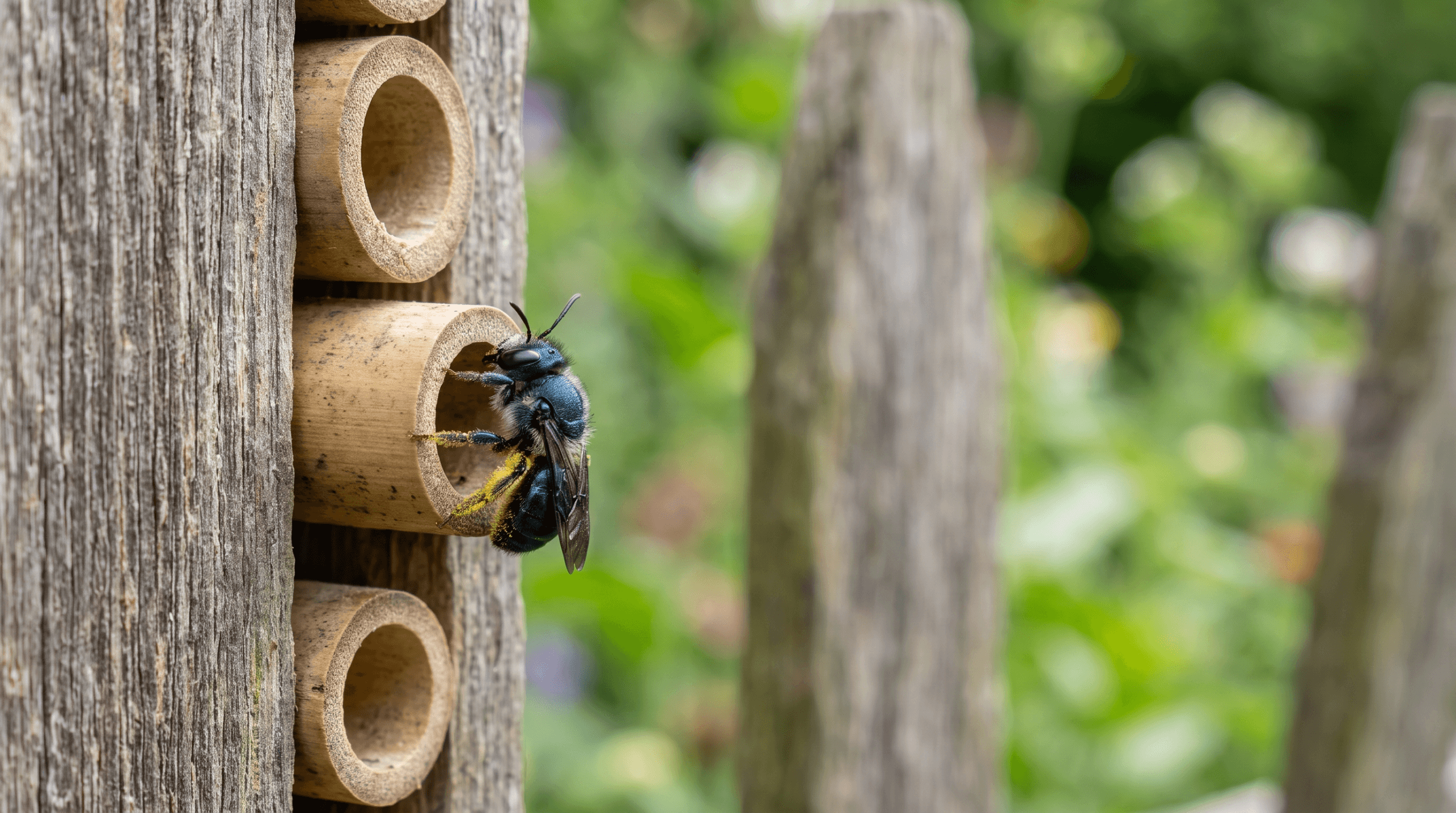
Mason Bees Are Not What Most People Think of When They Think “Bee”
When most gardeners hear “bee,” they picture a hive, honey, and a queen. Mason bees are none of those things. They’re solitary, non-colonial bees — each female is her own queen, builds her own nest, and raises her own brood. There’s no hive, no honey, and almost no stinging risk. A mason bee will sting only if physically pinned against your skin. They’re gentle, fascinating insects, and they’re arguably more valuable to your vegetable garden than honeybees.
The blue orchard mason bee (Osmia lignaria) is the species most commonly attracted to garden bee houses in North America. It’s native across most of the continent, metallic blue-black in color, and roughly the size of a housefly. Mason bees are spring pollinators — they emerge when temperatures warm consistently to around 55°F and are active for 4 to 8 weeks, typically March through May depending on your location. They’re busy exactly when fruit trees, early vegetables, and spring flowers need pollination most.
Research has compared their pollination efficiency to honeybees, and the numbers are striking. One mason bee pollinates as effectively as about 100 honeybees because of how they carry pollen. Honeybees dampen pollen and pack it tightly in their leg baskets, which reduces the amount transferred to flowers. Mason bees carry dry pollen loosely on their abdominal hairs — called a scopa — and they’re sloppy about it in the best possible way, spreading pollen everywhere they land.
Where to Put a Bee House and Why Placement Matters
A mason bee house is essentially a collection of hollow tubes or tunnels where females can lay eggs. You can buy one, build one, or use simple paper straws bundled together — the materials matter less than the dimensions. The critical measurement is the interior diameter of the tubes: 5/16 inch (about 8mm) for blue orchard mason bees. Too small and the bees won’t use them; too large and pests move in instead.
Tube length should be at least 6 inches — ideally 8 inches — so females can lay multiple eggs per tube. Shorter tubes mean less brood per nesting female, which limits your population over time. Avoid houses with tubes shorter than 4 inches; they’re often decorative rather than functional.
Placement is where most bee house failures happen. Mason bees need warmth — they’re cold-blooded and emerge and become active faster when the nest is warm. Face the house east or southeast so it catches morning sun. An east-facing location warms up quickly after cold nights, which is exactly what you want in early spring. South-facing houses get hot in summer, which can stress larvae as they develop through summer and fall.
Mount the house 6 to 7 feet off the ground — above deer reach and in a stable location that won’t swing in wind. Mason bees are good navigators and will find the house from distance, but they need stable visual landmarks nearby: a fence post, a building corner, a large shrub. Houses mounted on swaying branches are often abandoned.
The Mud Source They Need But You Might Forget
This is the detail that separates bee houses that work from ones that don’t. Mason bees get their name from how they build — they seal each egg chamber in their tubes with mud. After laying an egg on a pollen ball, a female mason bee makes multiple trips to a mud source to collect wet soil, which she uses to plug the chamber before starting the next one.
If there’s no mud source within about 50 feet of your bee house, the females will not use it — or will use it and then abandon it when they can’t find mud. Create a simple mud patch near the house: dig out a small area, fill it with clay-heavy soil (not sandy garden soil), and keep it consistently moist. A shallow tray of moist potter’s clay works too. This single addition makes a bigger difference in attracting nesting females than almost anything else.
Flowers That Bring Mason Bees to Your Garden
Mason bees are generalist foragers — they visit a wide range of flowering plants — but they particularly favor fruit tree blossoms, willows, maples, and native spring wildflowers. In a vegetable garden, they’re excellent pollinators of brassicas allowed to bolt, strawberries, peas, and early fruiting crops.
Plant spring-blooming flowers near the bee house: fruit trees of any kind are ideal, but crocus, dandelions, rosemary in bloom, native violets, and phacelia (an excellent bee plant that’s easy to grow from seed) all attract and support mason bees during their short active window. Avoid spraying any pesticides — including organic ones — during the mason bee flight season, as even OMRI-listed products can harm native bees on contact.
Why Your Vegetable Garden Will Thank You
The timing of mason bee activity lines up beautifully with early vegetable crops. Strawberries pollinated by mason bees produce larger, more symmetrically shaped fruit — poorly pollinated strawberries get that misshapen look because only some ovules were fertilized. Peas, beans planted in early May, cucumbers transplanted out early, and brassicas all benefit from the dense, efficient pollination these bees provide.
Building a mason bee population takes two to three seasons. The first year you put up a house, a few females may nest. Those eggs overwinter as adults inside their cocoons, emerge the following spring, and the population can grow exponentially if they have everything they need — house, mud, and forage. Give it a few years before deciding it isn’t working.