Few things beat cutting open a cold, homegrown watermelon on a hot summer afternoon. Watermelons need heat, space, and patience — but they reward you with something no grocery store can match.
Choosing the Right Variety
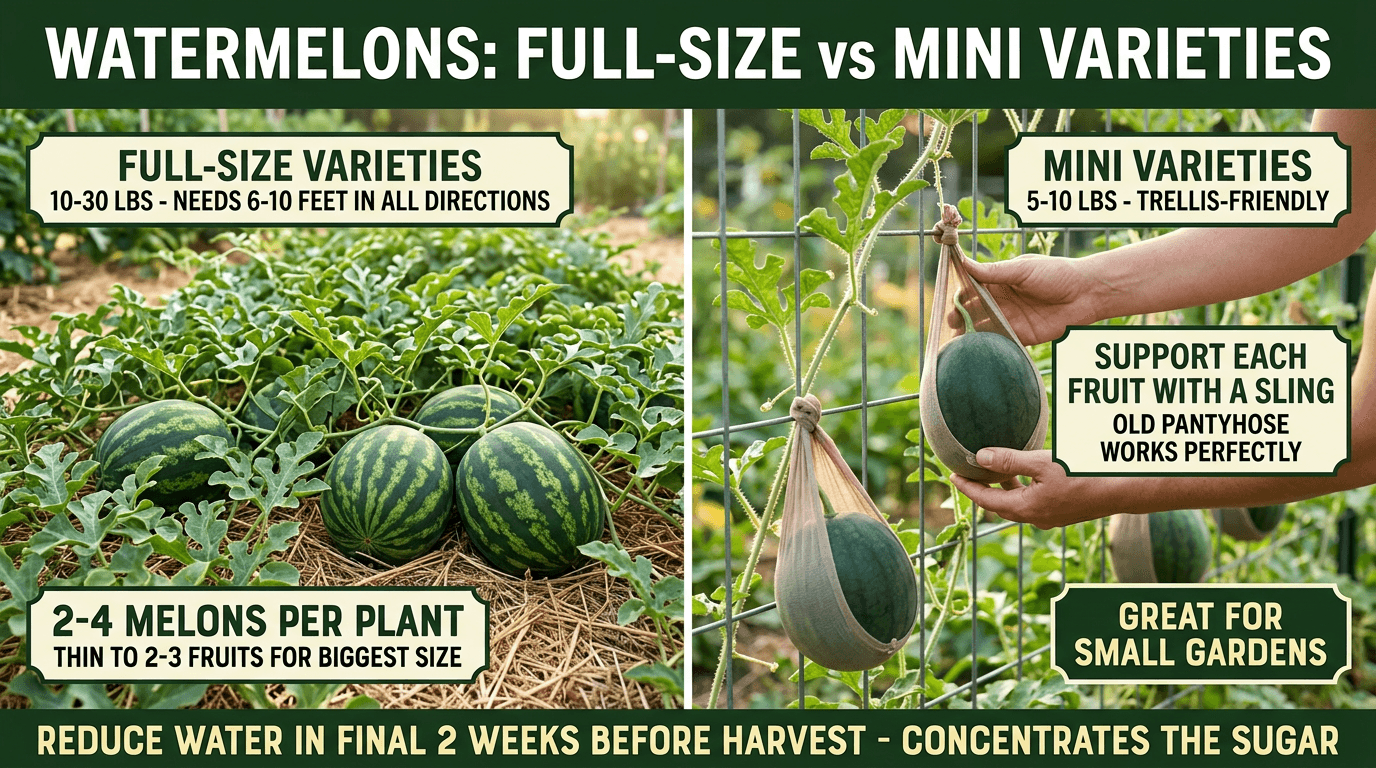
Full-size varieties (Crimson Sweet, Sugar Baby, Charleston Gray): 10–30 lbs. Need 80–100 days and lots of space. Best flavor.
Mini varieties (Sugar Baby, Golden Midget, Blacktail Mountain): 5–10 lbs. 70–80 days. Easier in small gardens and cooler climates. Trellis-friendly.
Seedless varieties: Require a standard variety planted nearby as a pollinator. Seedless plants cannot pollinate themselves.
Quick tip: For zones 3–5, choose Blacktail Mountain (70 days) or Golden Midget (70 days). Start indoors and use black plastic mulch to warm the soil.
When to Plant Watermelons
- Zones 3–5: Start indoors 3–4 weeks before last frost; transplant after frost when soil is 70°F+
- Zones 6–7: Direct sow or transplant after last frost, mid-May
- Zones 8–10: Direct sow March–April; possible fall crop
Watermelons need even more heat than cantaloupes. Soil under 70°F means slow growth and poor fruit set. Black plastic mulch is strongly recommended in zones 3–6.
Space Requirements
This is where watermelons differ most from other vegetables.
- Full-size varieties: Each plant needs 6–10 feet in every direction. Plan for 1–2 plants per raised bed.
- Mini varieties on a trellis: Can grow vertically with a sturdy trellis. Support each fruit in a cloth sling — an old pantyhose leg works perfectly.
One healthy full-size watermelon plant produces 2–4 melons per season.
How to Plant Watermelons
Direct sow: 2–3 seeds per hill, 1 inch deep. Hills 6–8 feet apart (3–4 feet for mini varieties on trellis). Thin to 1 plant per hill.
Transplants: plant at pot depth, handle roots carefully. Water immediately after planting.
Watering Watermelons
Watermelons are 95% water — and that shows in how much they need during the growing season.
- 1–2 inches per week during vine growth and flowering
- Water at the base only — wet leaves and fruit invite disease
- Reduce water in the final 2 weeks before harvest — this concentrates the sugars and improves sweetness dramatically
Fertilizing Watermelons
- At planting: compost worked into soil
- When vines reach 12 inches: balanced fertilizer (10-10-10)
- At first flowering: switch to low-nitrogen (5-10-10) to favor fruit over foliage
Too much nitrogen gives you huge sprawling vines with no fruit. Ease off once flowers appear.
When Is a Watermelon Ripe?
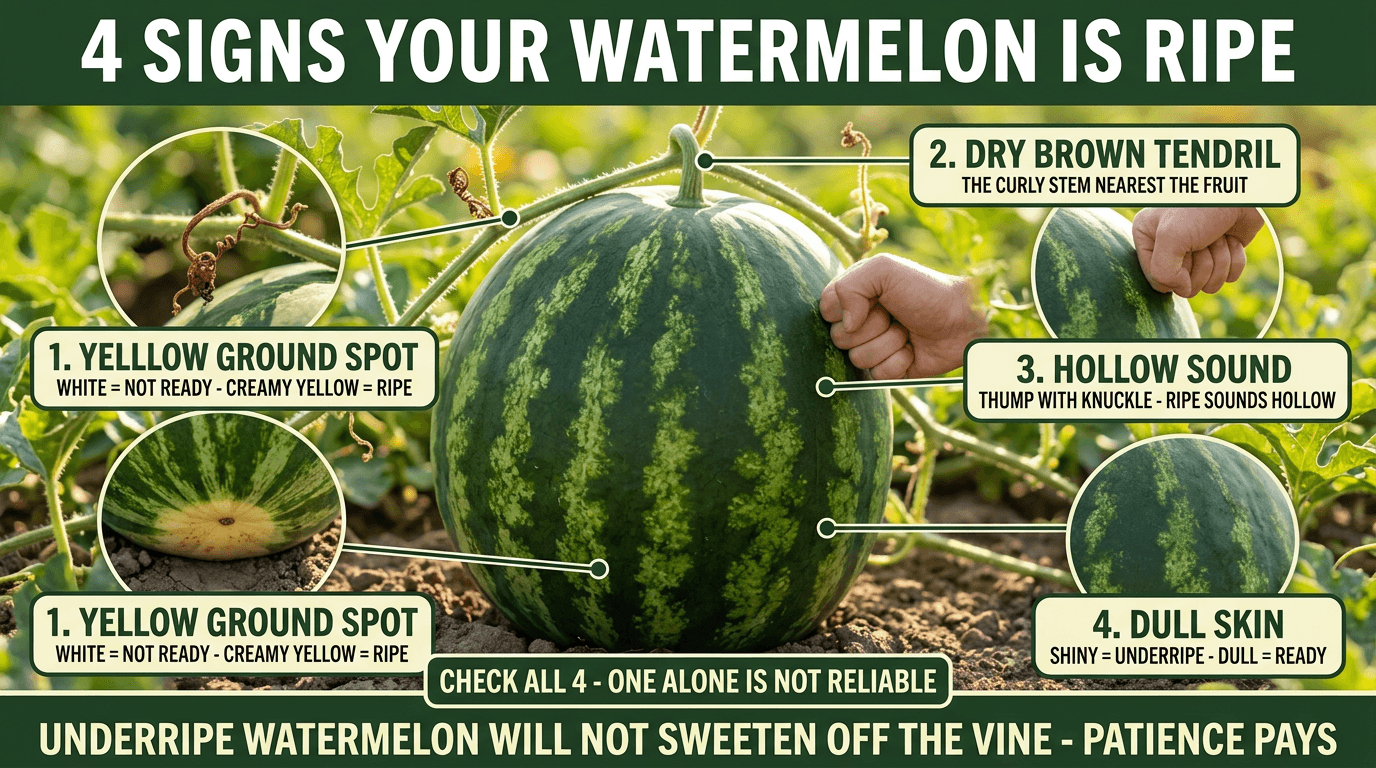
This is the hardest part. Check all four signs together:
- Ground spot: The patch resting on soil turns from white to creamy yellow
- Tendril: The curly tendril closest to the fruit dries out and turns brown
- Sound: Thump with your knuckle — ripe sounds hollow, underripe sounds higher-pitched
- Surface texture: Shiny skin becomes slightly dull
Look for all four signs. One alone is not reliable. An underripe watermelon will not sweeten off the vine.
Common Problems
No fruit despite flowers: Poor pollination. Plant flowers nearby or hand-pollinate.
Cracked fruit: Inconsistent watering or sudden rain after a dry spell. Reduce water gradually as fruit nears maturity.
Fruit won’t size up: Too little heat or too many fruits per vine. Thin to 2–3 fruits per plant for the largest melons.
Powdery mildew late season: Usually doesn’t affect fruit. Improve airflow between vines.